401(k) and IRA Early Withdrawal Penalty: Rules and Exceptions
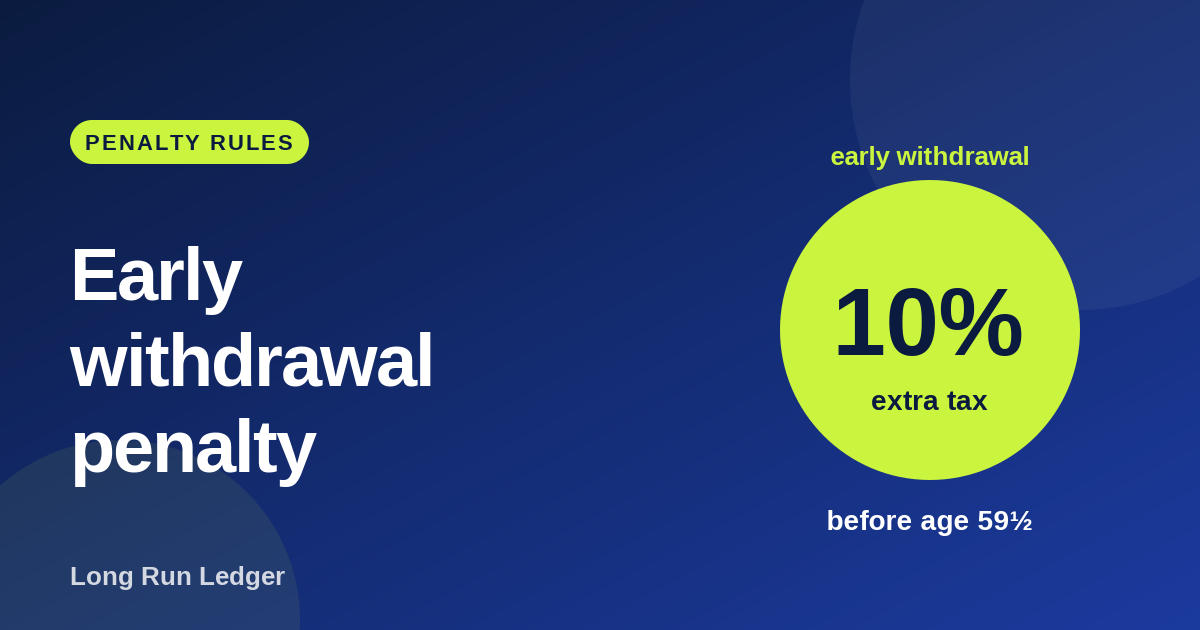
If you take money from a 401(k) or traditional IRA before age 59½, the IRS generally adds a 10% additional tax on the taxable part, on top of regular income tax. Roth IRAs have their own rules, covered below.
See the cost. Try your amount in the 401(k) withdrawal tax calculator.
What it costs
Say you withdraw $20,000 and your top bracket is 24%. Income tax is about $4,800 and the penalty is $2,000, so roughly $6,800 (34%) goes to tax, before any state tax. If a 401(k) pays you directly it also withholds 20%, so you might receive about $16,000 up front and settle the difference when you file.
Common exceptions
The IRS lists many exceptions. The main ones, with some applying only to certain accounts:
- Both IRAs and 401(k)s: disability, death, terminal illness, substantially equal periodic payments, certain unreimbursed medical expenses, an IRS levy, qualified reservist distributions, birth or adoption (up to $5,000 per child), domestic abuse, qualified disasters, and personal or family emergency expenses (up to $1,000 per year).
- 401(k) only: leaving your job in or after the year you turn 55 (the “rule of 55”), and payments to an ex-spouse under a court order.
- IRA only: up to $10,000 toward a first home, qualified higher-education costs, and health insurance premiums while unemployed.
Rules and dollar limits change, so check your own situation against the IRS page on exceptions to the tax on early distributions and Form 5329. An exception removes the 10% penalty, not the income tax.
Roth IRA withdrawals
Contributions to a Roth IRA come out first and can be withdrawn at any time with no tax or penalty. Earnings are taxable and penalized before 59½ unless the withdrawal is qualified or an exception applies. Converted amounts have a five-year clock. See the Roth five-year rule and Roth conversion ladder.
Substantially equal payments (72(t))
You can take a fixed stream of payments from an IRA before 59½ without the penalty, but they must continue for five years or until 59½, whichever is longer. Changing the payments early can trigger the penalty retroactively. It is rigid, so get professional help.
401(k) loans and leaving your job
A repaid 401(k) loan is not a distribution. If you leave your job with a balance outstanding, it can be treated as one, though you generally have until your tax filing deadline to roll over the amount and avoid tax and penalty.
How to avoid the penalty
- Keep an emergency fund so retirement money stays untouched.
- Use Roth contributions or a taxable account as your bridge in early retirement.
- Build a conversion ladder if you plan to retire early.
- Use a direct rollover when changing jobs, so the money is never paid to you.
See also how 401(k) withdrawals are taxed.
Related guides: rule of 55, 72(t) payments, Roth IRA withdrawal rules, Form 1099-R explained