Form 8606 Explained: When to File and How to Fill It Out
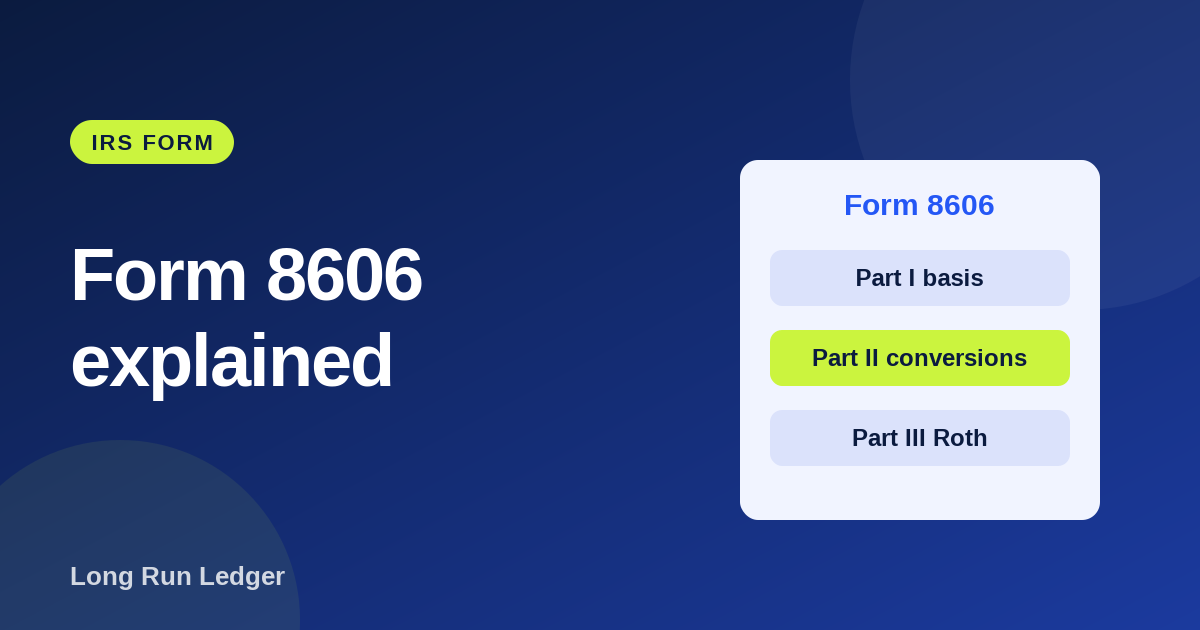
Form 8606, “Nondeductible IRAs,” is the form that tracks your after-tax (basis) money in traditional IRAs. You also use it to report Roth conversions and certain Roth IRA withdrawals.
Why it matters: Form 8606 is how the IRS knows part of your IRA was already taxed, so you aren’t taxed on it twice.
When you must file it
The IRS instructions say to file Form 8606 if any of these apply for the year:
- You made nondeductible contributions to a traditional IRA.
- You took money out of a traditional, SEP or SIMPLE IRA that has basis.
- You converted money from a traditional IRA to a Roth IRA, including a backdoor Roth.
- You took distributions from a Roth IRA (other than certain rollovers).
- You inherited an IRA that has basis.
The three parts
| Part | What it covers |
|---|---|
| Part I | Nondeductible contributions to traditional IRAs, and distributions from traditional IRAs, including your basis |
| Part II | Conversions from traditional IRAs to Roth IRAs in the year |
| Part III | Distributions from Roth IRAs |
An example: the backdoor Roth
You contribute $7,500 to a traditional IRA and don’t deduct it, so $7,500 is basis. A few days later you convert the whole IRA to a Roth. If you have no other pre-tax IRA money, Part I shows your basis, and Part II shows a conversion of $7,500 that is almost entirely tax-free. Only the small gain between contribution and conversion is taxable.
If you do have other pre-tax IRA money, the pro-rata rule makes part of the conversion taxable, and the form is where it is figured. See the backdoor Roth guide.
Deadline and where to send it
File it with your Form 1040, 1040-SR or 1040-NR by the due date, including extensions. If you aren’t required to file a return, you still need to file Form 8606 on its own: sign it, include your address, and mail it to the IRS address where you would file a return.
Penalties
- $50 for not filing it when required, unless you show reasonable cause.
- $100 for overstating your nondeductible contributions, unless you show reasonable cause.
Records to keep
Keep each year’s Form 8606, your tax returns for years with nondeductible contributions, Form 5498 (IRA contribution statements), year-end IRA value statements and Forms 1099-R, until all of your IRA money has been withdrawn. Missing records can make it hard to prove basis later. See how to pay taxes on a Roth conversion and the retirement tax deadlines.
Always follow the current IRS instructions for Form 8606, and consider a tax professional if you have several IRAs or past nondeductible contributions.
Related guides: Form 1099-R explained, Roth IRA withdrawal rules