The Future Value Formula, With Worked Examples
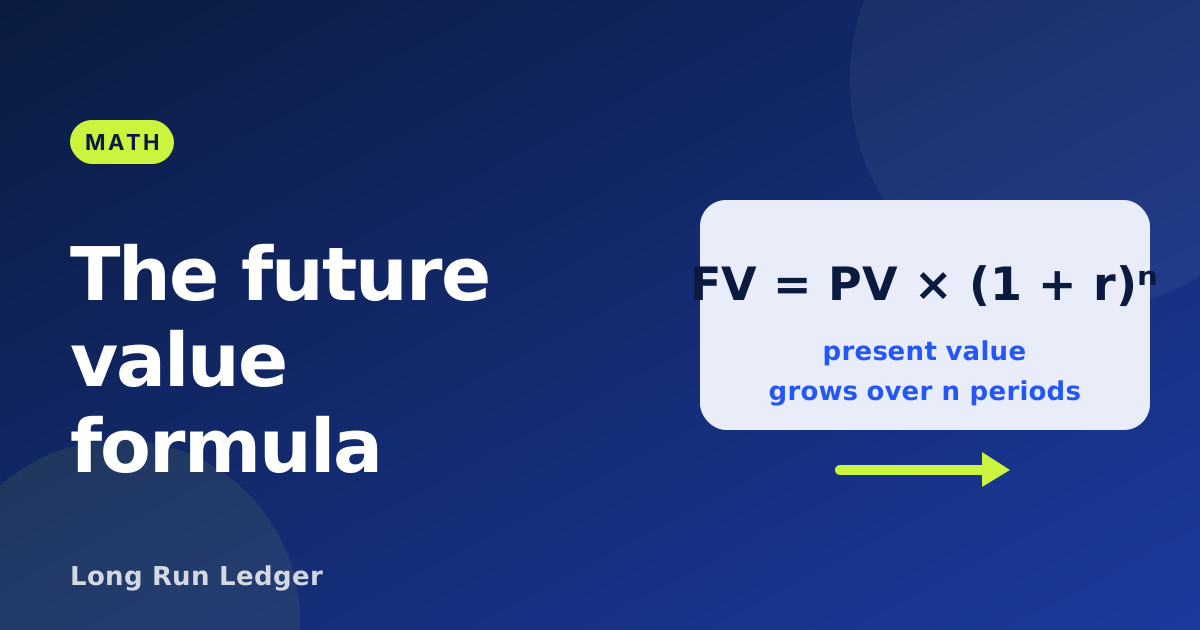
Future value tells you what money today could be worth later if it earns a steady return. There are two formulas to know: one for a lump sum, and one for regular contributions.
Check the math. The compound interest calculator does these calculations and shows a year-by-year table.
Lump sum
FV = PV × (1 + r)n, where PV is the amount today, r is the return per period and n is the number of periods.
Example: $10,000 at 7% a year for 20 years. FV = 10,000 × 1.0720 = $38,697. The same money compounded monthly (r = 0.07 ÷ 12, n = 240) grows slightly more, to about $40,387.
Regular contributions
FV = PMT × ((1 + i)N − 1) ÷ i, where PMT is the contribution each period, i is the rate per period and N is the number of periods. This version assumes contributions are made at the end of each period.
Example: $500 a month at 7% compounded monthly for 30 years. i = 0.07 ÷ 12 and N = 360. FV = 500 × ((1.005833)360 − 1) ÷ 0.005833 = $609,985.
Both together
Add the two results. Starting with $10,000 and adding $500 a month for 30 years: about $81,165 from the lump sum plus $609,985 from the contributions gives $691,150.
Adjusting for inflation
Divide the future value by (1 + inflation)years. At 3% inflation, $691,150 in 30 years is worth about $284,700 in today’s dollars.
The rule of 72
A quick check: 72 ÷ the return in percent is roughly how many years it takes to double. At 7% that’s about 10 years.
Next steps
Put your own numbers into the calculator, read how compound interest builds retirement savings, and see the effect inside a tax-free account with the Roth IRA calculator.