What Is a Roth Conversion? How It Works and What It Costs
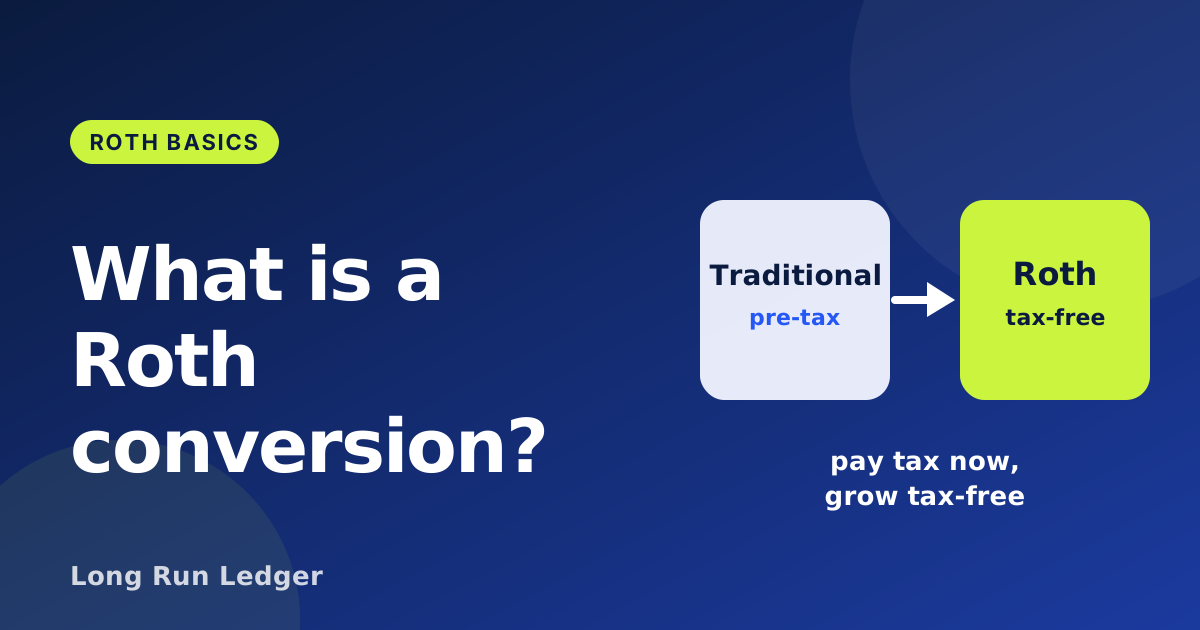
A Roth conversion is when you move money from a traditional IRA, or another pre-tax retirement account, into a Roth IRA. You pay ordinary income tax on the pre-tax amount you convert. After that, the money grows tax-free and can come out tax-free once you meet the Roth rules.
See what a conversion would cost you. Try the Roth conversion calculator.
How a Roth conversion works
- You choose an amount to move from a traditional IRA, or roll pre-tax money from an old 401(k), into a Roth IRA.
- The pre-tax portion is added to your taxable income for that year and taxed at ordinary rates.
- From then on, the money grows inside the Roth IRA without further tax.
Unlike Roth contributions, conversions have no income limit and no dollar cap. You do have a deadline: a conversion must be completed by December 31 to count for that tax year. For 2026, that means before the year ends.
What a conversion costs: an example
Say you’re a single filer with $60,000 of income. After the 2026 standard deduction of $16,100, your taxable income is $43,900. You convert $20,000.
| Slice of the conversion | Tax rate | Tax |
|---|---|---|
| $6,500 (fills the rest of the 12% bracket) | 12% | $780 |
| $13,500 (spills into the 22% bracket) | 22% | $2,970 |
| Total on $20,000 | 18.75% average | $3,750 |
The conversion is taxed bracket by bracket, so only the part above the top of the 12% bracket ($50,400 of taxable income) is taxed at 22%. These figures use the 2026 federal brackets from IRS Revenue Procedure 2025-32. State income tax is extra.
Why people convert
- Tax-free growth: qualified Roth withdrawals are tax-free, so future growth is never taxed.
- No required withdrawals: Roth IRAs have no required minimum distributions for the original owner.
- Tax diversification: having both pre-tax and Roth money gives you more control over your tax bill in retirement.
- Heirs: beneficiaries generally get Roth money without income tax on qualified withdrawals.
- Low-income years: a gap year, early retirement, or time between jobs can make conversions cheaper.
When it may not make sense
- You expect a lower tax rate in retirement than the rate you’d pay now.
- You’d have to pay the tax out of the IRA itself instead of from other savings.
- You may need the money within about five years.
- The extra income would push you into a much higher bracket or trigger the side effects below.
Side effects to check before converting
Conversion income raises your adjusted gross income, which can have ripple effects:
- Medicare Part B and Part D premiums can rise two years later (IRMAA surcharges).
- Premium tax credits for health insurance bought through the ACA marketplace can shrink.
- More of your Social Security benefits can become taxable.
- State income tax may apply.
Rules to know
- You can’t undo it. Since 2018, a Roth conversion can’t be recharacterized back to a traditional IRA.
- Each conversion has a five-year clock. Withdrawing converted amounts within five years, before age 59½, can trigger a 10% penalty.
- Pay the tax from outside money if you can. Withholding tax from the conversion shrinks what lands in the Roth, and before 59½ the withheld amount can count as an early withdrawal.
- The pro-rata rule may apply. If you also hold after-tax money in traditional IRAs, part of your conversion is tax-free and part is taxable. See our backdoor Roth guide.
A common approach: convert up to the edge of a bracket
Instead of one large conversion, many people convert a set amount each year, stopping before the next bracket begins. This keeps the tax rate on the conversion predictable. The Roth conversion calculator shows how much room you have left in your current bracket, and the average tax rate on whatever amount you enter.
Bottom line
A Roth conversion trades a tax bill now for tax-free growth later. It tends to work best when your tax rate today is lower than you expect it to be in retirement, and when you can pay the tax with money from outside the IRA. Run your own numbers before you decide.