Roth IRA Contribution Limits for 2026 and 2027
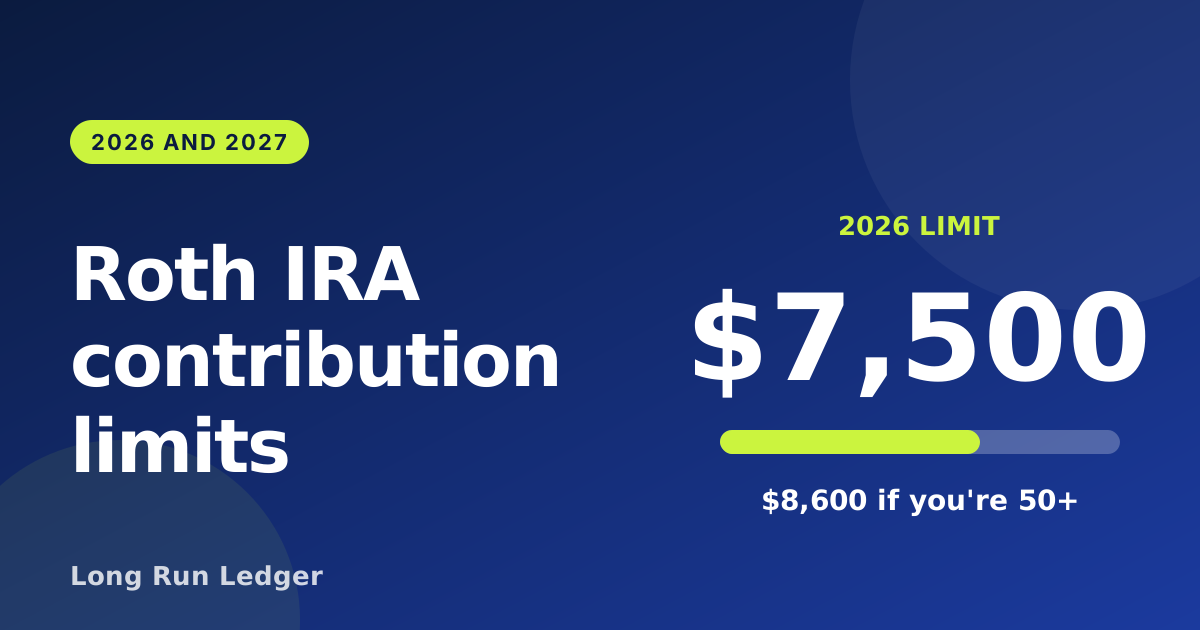
The most you can put in a Roth IRA for 2026 is $7,500, or $8,600 if you’re 50 or older. Your income can lower that amount or remove it entirely, and the limit is shared with any traditional IRA you contribute to. The numbers below come from the IRS’s annual inflation adjustments.
Check your own limit. Enter your income in the Roth IRA calculator to see exactly what you can contribute, and what your balance could grow to.
Roth IRA contribution limits at a glance
| 2026 | 2027 | |
|---|---|---|
| Contribution limit (under 50) | $7,500 | $7,500 |
| Catch-up contribution (age 50+) | $1,100 | $1,100 |
| Total if you’re 50 or older | $8,600 | $8,600 |
| Income phase-out: single or head of household | $153,000 to $168,000 | $158,000 to $173,000 |
| Income phase-out: married filing jointly | $242,000 to $252,000 | $250,000 to $260,000 |
| Income phase-out: married filing separately (lived with spouse) | $0 to $10,000 | $0 to $10,000 |
The married-filing-separately range isn’t adjusted for inflation. The IRS announced the 2027 figures on November 12, 2026.
One limit across all your IRAs
The limit is combined across your traditional and Roth IRAs. If you put $7,500 into a traditional IRA for 2026, you have no room left for a Roth contribution that year. You can split the limit however you like, as long as the total stays within it.
You need earned income
Your contribution can’t be more than your taxable compensation for the year, such as wages or self-employment income. If you’re married and file jointly, a spouse with little or no income can still have an IRA funded based on the working spouse’s earnings, as long as your combined compensation covers both contributions.
How the income phase-out works
Your eligibility depends on your modified adjusted gross income (MAGI):
- Below the range: you can contribute the full amount.
- Inside the range: your limit shrinks gradually.
- Above the range: you can’t contribute directly to a Roth IRA.
Income from a Roth conversion isn’t counted in MAGI for this purpose.
Example. A single filer under 50 has MAGI of $160,500 in 2026. The phase-out range is $153,000 to $168,000, a $15,000 span. They’re $7,500 into it, which is 50%, so their $7,500 limit is cut by half to about $3,750. The IRS worksheet in Publication 590-A applies rounding rules, so use it for your final figure.
Deadlines
You can make a 2026 contribution until the tax filing deadline in 2027, typically April 15. A 2027 contribution can be made until the filing deadline in 2028.
What happens if you contribute too much
An excess contribution is subject to a 6% tax for each year it stays in the account. You can avoid that by withdrawing the excess and any earnings by your tax filing deadline, including extensions, or by applying it to the next year’s limit. This can happen by accident if your income lands in the phase-out range, so check your MAGI before contributing.
If your income is too high
Above the phase-out range, you can’t contribute to a Roth IRA directly, but you may be able to use a backdoor Roth. That means making a nondeductible traditional IRA contribution and converting it. It comes with a catch called the pro-rata rule, which we explain in our backdoor Roth guide. If you already have pre-tax IRA money, see what a Roth conversion is first.
401(k) limits are separate
What you put in a workplace plan doesn’t count against your IRA limit. The 401(k) employee contribution limit is $24,500 for 2026 and rises to $25,500 for 2027. A Roth 401(k) has no income limit, though your employer’s plan has to offer one.
Bottom line
Plan on $7,500 a year ($8,600 at 50 and older) as your Roth IRA ceiling for 2026 and 2027, and check where your MAGI falls in the phase-out range. If you’re near the limit, small changes in income can change what you’re allowed to contribute.