How to Convert a Traditional IRA to a Roth IRA, Step by Step
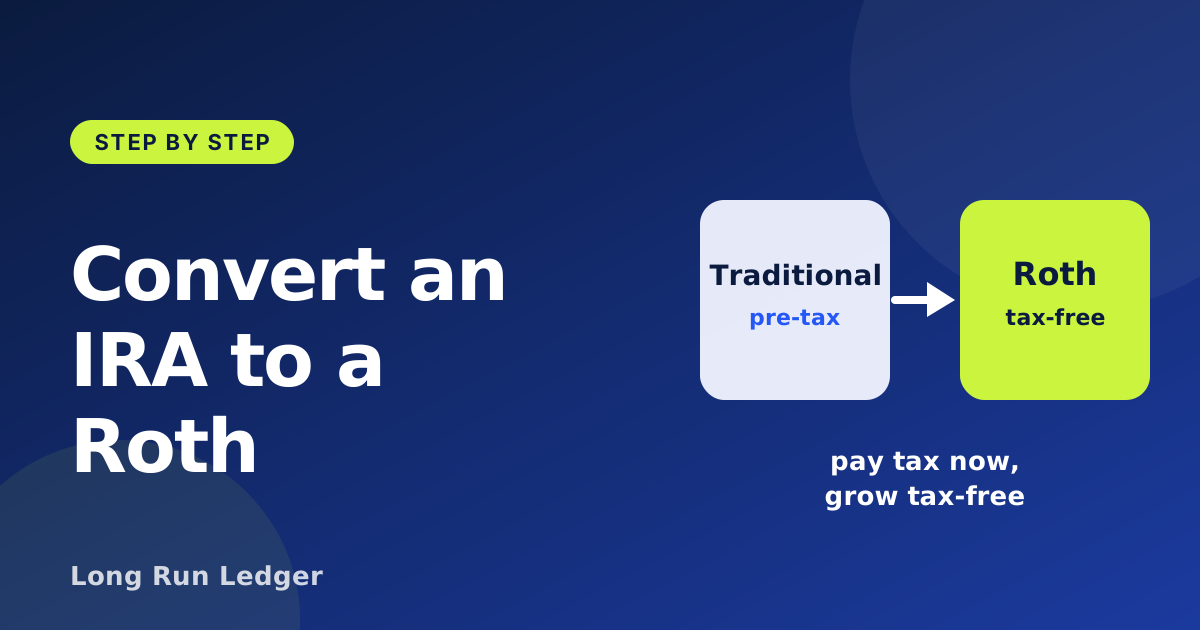
Converting a traditional IRA to a Roth IRA means paying income tax now on the pre-tax money you move, in exchange for tax-free growth and withdrawals later. The mechanics are simple. The planning is where people go wrong. If you’re new to the idea, start with what a Roth conversion is.
Estimate the tax first. Run your numbers in the Roth conversion calculator before you move any money.
Step by step
- Decide how much to convert. A common approach is to convert only enough to “fill” your current tax bracket, so the extra income is taxed at a rate you’re comfortable with.
- Open a Roth IRA if you don’t have one. It can be at the same provider as your traditional IRA. See how to open a Roth IRA.
- Request the conversion. Most providers have an online form. Choose “convert” (not “contribute”), name the source and destination accounts, and enter the amount.
- Choose what to do about withholding. The cleanest approach is to convert the full amount and pay the tax from outside money, such as savings, using estimated payments or increased paycheck withholding. Withholding tax from the converted amount means less goes into the Roth.
- Invest the converted money. Like a new contribution, it may land in cash until you choose investments.
- Complete it by December 31. A conversion counts for the tax year in which it happens, so a 2026 conversion has to be completed by December 31, 2026.
- File the paperwork. Your provider sends a Form 1099-R. You report the conversion on Form 8606 and your tax return.
Watch out for the pro-rata rule
If you also have pre-tax and after-tax (nondeductible) money across your traditional, SEP and SIMPLE IRAs, you can’t pick which dollars you convert. The IRS looks at all of those balances together, and each conversion is taxed in proportion. Our backdoor Roth guide shows a worked example.
Converting from a 401(k)
Some plans offer an in-plan Roth conversion. Otherwise you can roll an old employer plan into a traditional IRA and convert from there, or roll it directly to a Roth IRA and pay tax on the pre-tax amount. Ask the plan administrator which options apply.
Mistakes to avoid
- Converting too much in one year, which pushes you into a higher bracket than necessary.
- Paying the tax from the converted money, especially if you’re under 59½, because the amount withheld can be treated as an early distribution and may owe a 10% penalty.
- Forgetting that you can’t undo it. Since 2018 a conversion can’t be recharacterized back to a traditional IRA.
- Ignoring side effects. A larger income year can raise Medicare premiums (IRMAA), reduce ACA subsidies, and make more Social Security benefits taxable.
- Skipping the five-year rule. Each conversion has its own five-year clock for the 10% penalty on withdrawals before 59½.
When it can make sense
Conversions tend to be most attractive in a low-income year, such as a gap between jobs or the early years of retirement, or when you expect higher tax rates later. Test it with the Roth conversion calculator, which uses the 2026 and 2027 federal brackets.