RMD Table: IRS Uniform Lifetime Table for 2026 (Ages 72–120+)
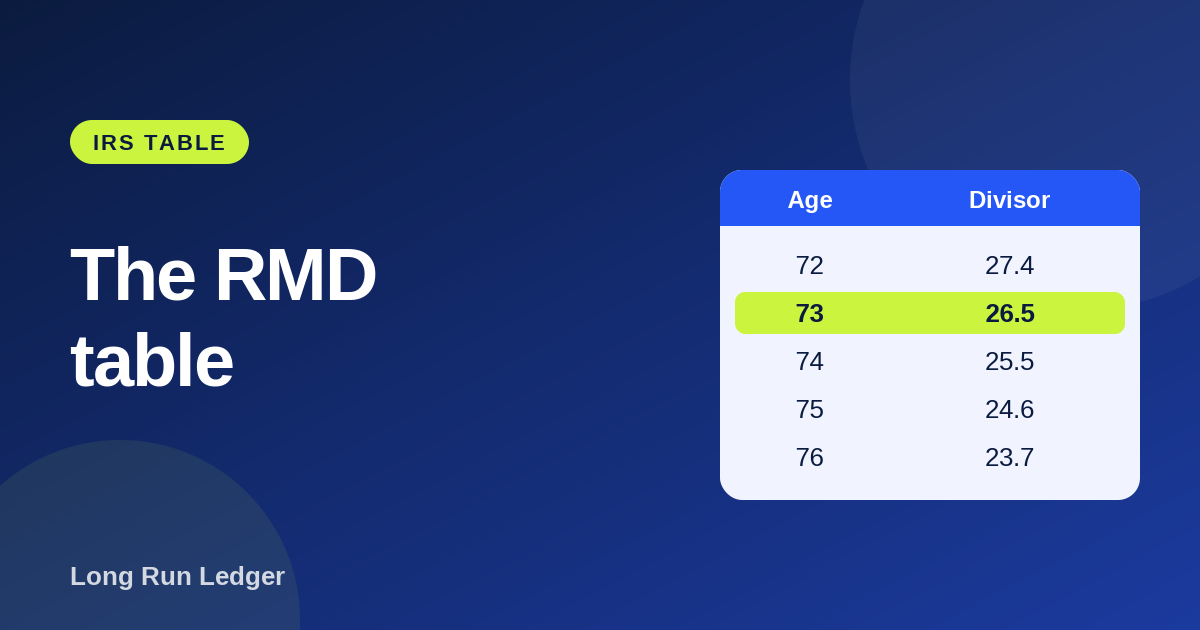
Most retirees use one table to work out their required minimum distribution: the IRS Uniform Lifetime Table (Table III in IRS Publication 590-B). Divide your account balance at the end of last year by the number next to your age.
Skip the math. Enter your balance and birth year in the RMD calculator.
Uniform Lifetime Table
| Age | Divisor | Age | Divisor |
|---|---|---|---|
| 72 | 27.4 | 97 | 7.8 |
| 73 | 26.5 | 98 | 7.3 |
| 74 | 25.5 | 99 | 6.8 |
| 75 | 24.6 | 100 | 6.4 |
| 76 | 23.7 | 101 | 6.0 |
| 77 | 22.9 | 102 | 5.6 |
| 78 | 22.0 | 103 | 5.2 |
| 79 | 21.1 | 104 | 4.9 |
| 80 | 20.2 | 105 | 4.6 |
| 81 | 19.4 | 106 | 4.3 |
| 82 | 18.5 | 107 | 4.1 |
| 83 | 17.7 | 108 | 3.9 |
| 84 | 16.8 | 109 | 3.7 |
| 85 | 16.0 | 110 | 3.5 |
| 86 | 15.2 | 111 | 3.4 |
| 87 | 14.4 | 112 | 3.3 |
| 88 | 13.7 | 113 | 3.1 |
| 89 | 12.9 | 114 | 3.0 |
| 90 | 12.2 | 115 | 2.9 |
| 91 | 11.5 | 116 | 2.8 |
| 92 | 10.8 | 117 | 2.7 |
| 93 | 10.1 | 118 | 2.5 |
| 94 | 9.5 | 119 | 2.3 |
| 95 | 8.9 | 120 and over | 2.0 |
| 96 | 8.4 |
Source: IRS Publication 590-B, Table III. The IRS calls the number the “applicable denominator.”
The formula
RMD = account balance on December 31 of the prior year ÷ divisor for your age this year.
- Age 73 with $500,000: $500,000 ÷ 26.5 = $18,868.
- Age 75 with $500,000: $500,000 ÷ 24.6 = $20,325.
- Age 85 with $300,000: $300,000 ÷ 16.0 = $18,750.
The divisor falls each year, so the required percentage rises, from about 3.8% at 73 to about 6.3% at 85.
When RMDs start
The starting age is 73 for people born in 1951 through 1959, and 75 for those born in 1960 or later. Your first RMD is due by April 1 of the year after you reach that age. Every later one is due by December 31. If you delay the first one to April 1, you must take two in that year, which can raise your tax bracket. See required minimum distributions explained.
Which table applies to you
- Uniform Lifetime Table (above): most account owners, including those whose spouse is the beneficiary and is less than 10 years younger.
- Joint Life and Last Survivor Table (Table II): if your spouse is more than 10 years younger and is the sole beneficiary of the account. It gives a smaller RMD.
- Single Life Table: for most beneficiaries who inherit an account.
Which accounts have RMDs
Traditional IRAs, SEP and SIMPLE IRAs, and workplace plans like 401(k) and 403(b) accounts. Roth IRAs and designated Roth accounts in employer plans have no RMDs while the owner is alive, so some people convert to a Roth before RMDs start. You can add up your IRA RMDs and take the total from any one of them, but 401(k) RMDs must be taken from each plan separately.
The penalty for missing one
The IRS says you may owe a 25% excise tax on the amount not taken, reduced to 10% if you fix it within two years. Taking an RMD also adds to your taxable income. See retirement tax planning and the withdrawal tax calculator.