When to Do a Roth Conversion (and When to Wait)
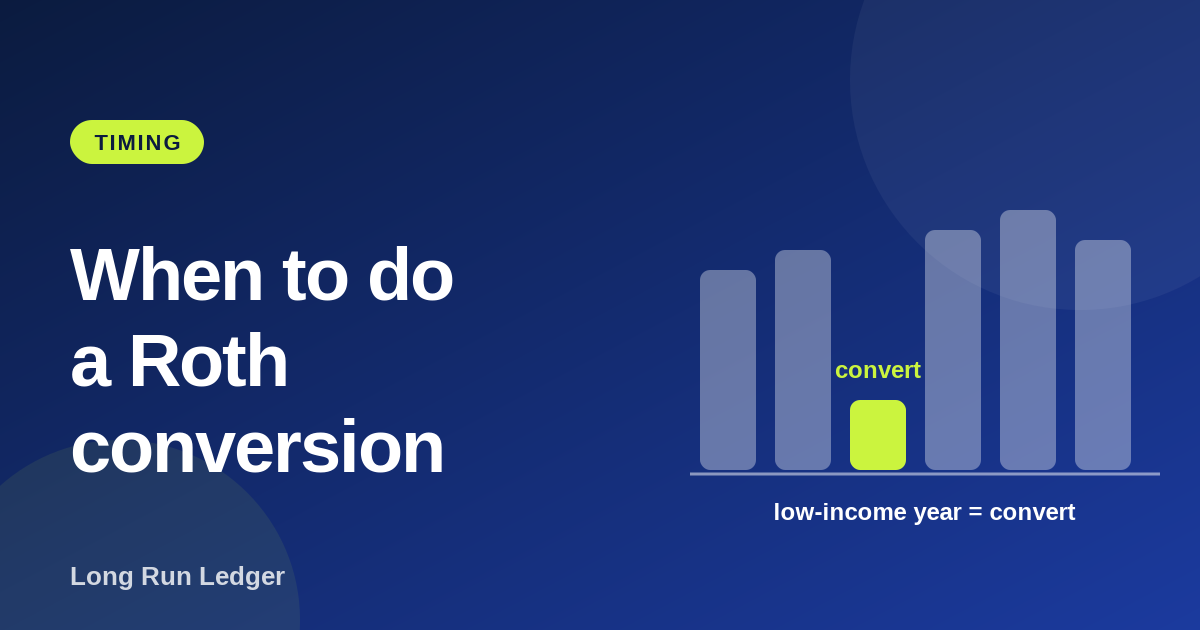
A Roth conversion makes sense when the tax rate you pay on the converted money today is lower than the rate you expect to pay on it later, and you can pay the tax with money from outside the retirement account.
Test an amount. The Roth conversion calculator shows the tax cost for 2026 and 2027.
The best times to convert
- Low-income years. A career break, a sabbatical, a job change, or a year with business losses can leave room in the 10% or 12% brackets.
- The gap between retirement and RMDs. After you stop working but before Social Security and required minimum distributions begin, your income may be unusually low.
- After a market drop. The same number of shares is worth less, so the tax is smaller, and the recovery happens inside the Roth tax-free.
- Before RMD age, so a smaller pre-tax balance means smaller forced withdrawals.
- Late in the year, once you know your income. You can’t undo a conversion, so being able to see the whole year helps.
Fill the bracket: partial conversions
You don’t have to convert everything. A common approach is to convert just enough to fill your current bracket. Example for a single filer in 2026 with $40,000 of taxable income: the 12% bracket runs to $50,400, leaving $10,400 of room. Converting $10,400 costs about $1,248 in federal tax. Converting more would start taxing the extra at 22%. See the 2026 and 2027 brackets.
One big conversion or several?
Spreading conversions across years usually keeps you in lower brackets than converting a large balance at once. The Roth conversion ladder does this on purpose for early retirees.
The deadline
A conversion counts for the calendar year in which it happens. The deadline for 2026 is December 31, 2026, and the tax is due with your 2026 return. Unlike IRA contributions, there is no extra time until April, and you can’t convert after year-end and apply it to the prior year. Brokerages and 401(k) plans may need requests days or weeks earlier. See retirement account tax deadlines.
When to wait or skip it
- You would need the converted money within about five years.
- You would have to pay the tax from the converted money.
- You are in your peak earning years and expect a lower rate in retirement.
- The extra income would push you across a threshold, such as higher Medicare premiums or the loss of health-insurance subsidies.
- You don’t have a large pre-tax balance, so there is little to gain.
A quick checklist
- Estimate your taxable income for the year.
- Find the room left in your bracket.
- Check for thresholds you would cross.
- Make sure you have cash for the tax. See how to pay taxes on a Roth conversion.
- Convert, then report it with your return.
New to this? Start with what is a Roth conversion and how to convert an IRA to a Roth. For a 401(k), see in-plan Roth conversions.