The 4% Rule, Explained: How Much Can You Withdraw in Retirement?
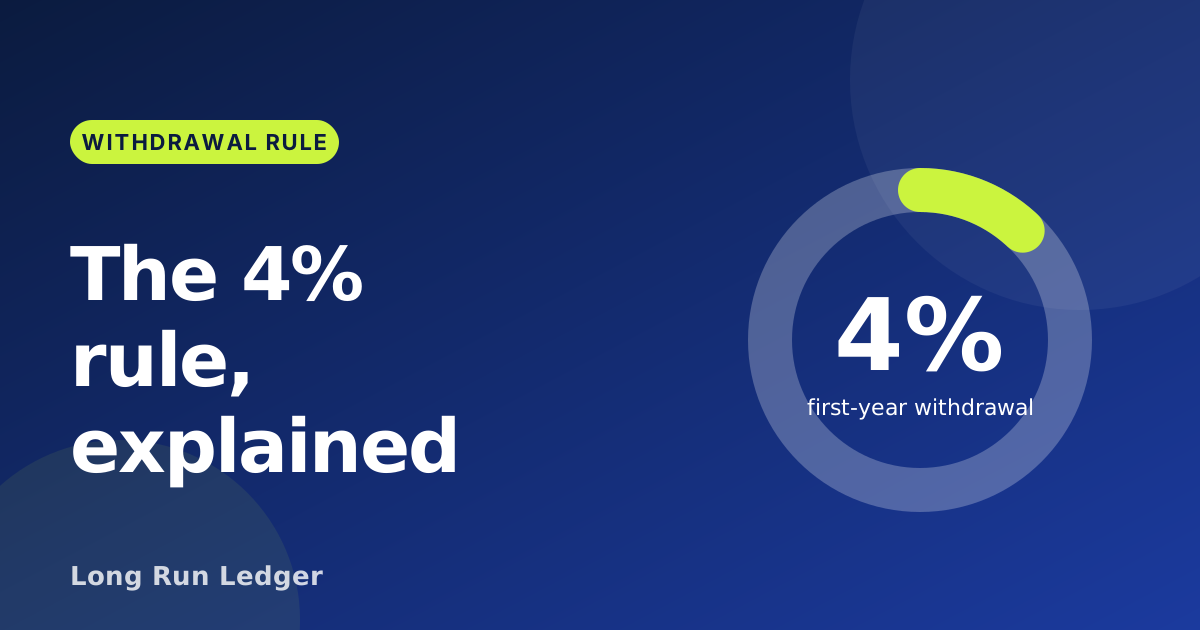
The 4% rule is a rule of thumb for retirement spending: take out 4% of your portfolio in your first year of retirement, then increase that dollar amount each year with inflation. It’s the basis of the “FIRE number.”
Get your number. The FIRE number calculator applies the rule to your own spending.
Where it came from
Financial planner William Bengen published research in 1994 testing how much retirees could withdraw from a mix of stocks and bonds over 30-year periods in US history. The Trinity study later looked at similar questions. A first-year withdrawal near 4% held up in most of the periods tested. It is a historical result, not a guarantee.
An example
You retire with $1,000,000. Year one you withdraw 4%, or $40,000. If inflation is 3%, year two you withdraw $41,200, whatever your balance did. Going the other way: if you want $60,000 a year, you need $60,000 ÷ 0.04 = $1,500,000. That’s the same as saving 25 times your yearly spending.
The limits of the rule
- Time horizon. It was built for about 30 years. Someone retiring at 40 may need a lower rate such as 3% to 3.5%.
- Sequence of returns. A bad market early in retirement hurts more than the same drop later.
- Fixed spending. Real life changes. Many retirees spend less when they’re older, and flexibility, like trimming spending in a down year, improves the odds.
- Taxes and fees. The rule doesn’t include them.
- Other income. Social Security, pensions or part-time work lower the amount your portfolio has to cover.
Using it for planning
| Withdrawal rate | Portfolio for $60,000 a year |
|---|---|
| 3% | $2,000,000 |
| 3.5% | $1,714,286 |
| 4% | $1,500,000 |
| 5% | $1,200,000 |
A lower rate means a bigger cushion and a larger target. See how your choice moves the date you could retire in the calculator, and compare lean, regular and fat FIRE. For ages that affect your plan, see the retirement age in the USA.