What Is the Retirement Age in the USA? Every Key Age From 59½ to 75
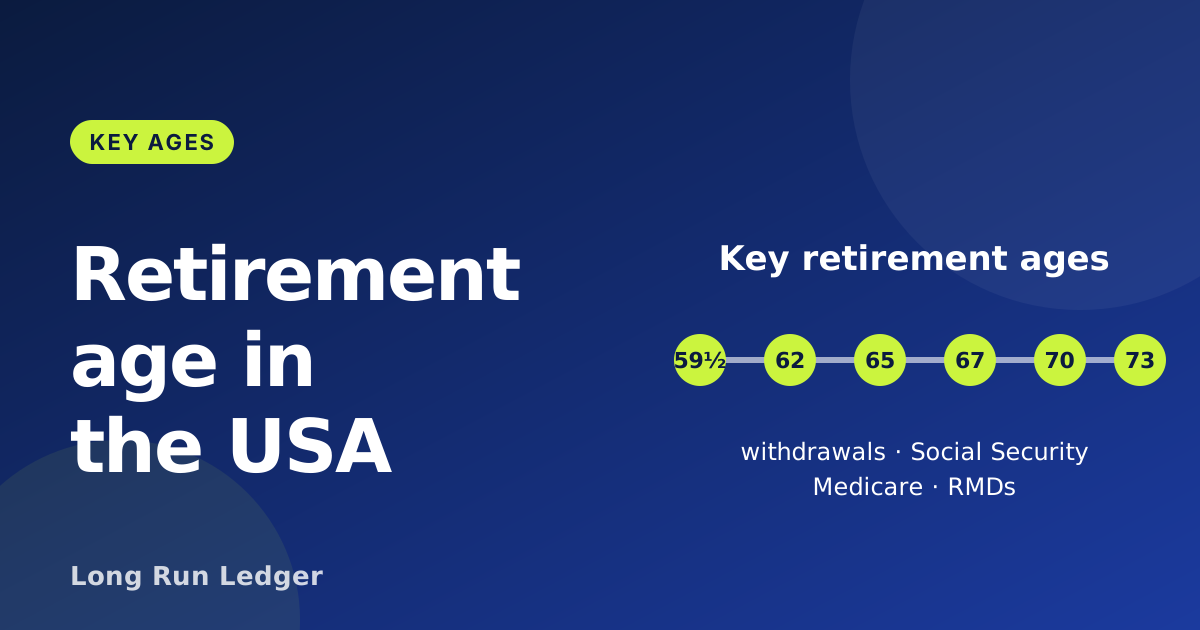
There isn’t one retirement age in the United States. Different rules switch on at different ages, and the best age for you depends on your savings, your health and your plans. Here are the ages that matter, in order.
Pick your own age. The FIRE number calculator shows how much you need to retire at the age you choose.
Age 59½: penalty-free withdrawals
You can generally take money out of a 401(k) or IRA after 59½ without the 10% early-withdrawal penalty. Regular income tax still applies to pre-tax accounts. Before 59½ there are exceptions, such as the rule of 55 for an employer plan if you leave that job in or after the year you turn 55, and Roth IRA contributions, which you can withdraw at any time. Also see the Roth five-year rule.
Age 62: earliest Social Security
You can claim Social Security retirement benefits as early as 62, but the monthly amount is permanently reduced. If your full retirement age is 67, claiming at 62 cuts your benefit by about 30%.
Age 65: Medicare
Medicare eligibility generally starts at 65, no matter when you claim Social Security. If you retire earlier, you need another source of health insurance until then. That’s a big cost for early retirees, and a reason many people consider Barista FIRE.
Age 67: full retirement age
For anyone born in 1960 or later, Social Security’s full retirement age is 67. For people born from 1955 to 1959 it’s between 66 and 2 months and 66 and 10 months, and it’s 66 for those born from 1943 to 1954. Claiming at full retirement age gives you your full benefit.
Age 70: the maximum benefit
For each year you delay past full retirement age, up to 70, your benefit grows by about 8%. At full retirement age 67, waiting until 70 gives roughly 24% more per month than claiming at 67. There’s no gain from waiting beyond 70.
Ages 73 and 75: required withdrawals
Required minimum distributions (RMDs) from traditional IRAs and 401(k)s start at 73 for people born from 1951 to 1959, and at 75 for those born in 1960 or later. Roth IRAs have no RMDs for the original owner, which is one reason people do Roth conversions.
So what age should you retire?
Retirement is a money question first. Work out what you’ll spend and how large a portfolio that needs with the 4% rule, then check how soon you could get there. If you’re already close, the Coast FIRE calculator shows when you could stop saving.
Check the current ages and amounts on the Social Security Administration and IRS websites before you make a decision, since rules can change.