How Much Do I Need to Retire? A Simple Way to Find Your Number
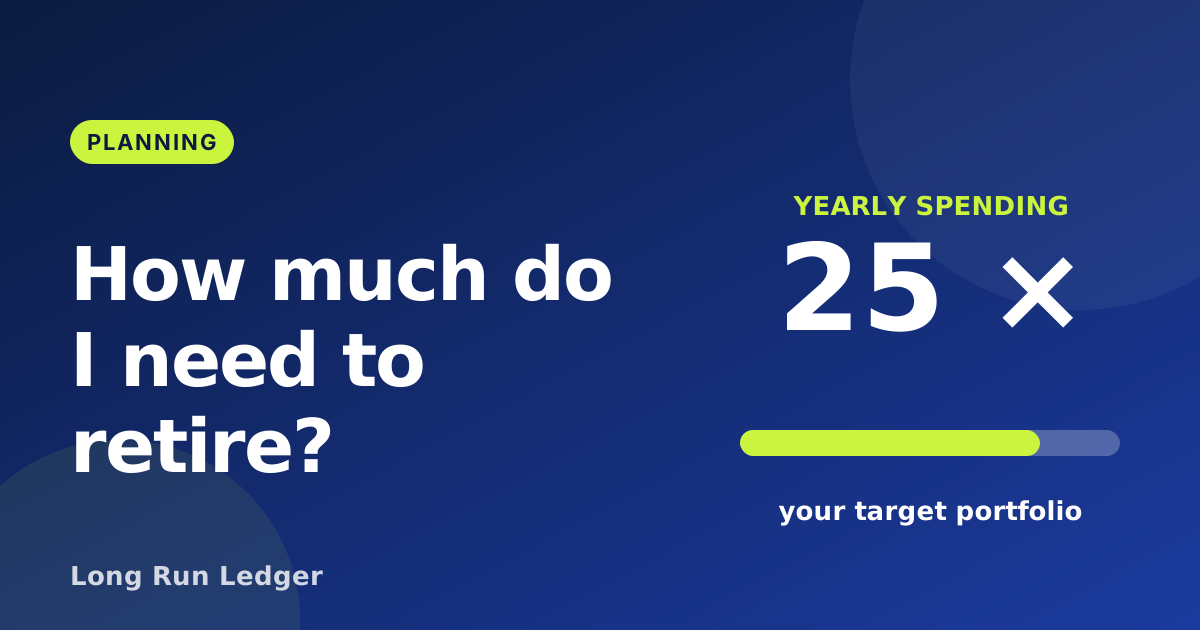
There is no single number that works for everyone. What you need depends on how much you’ll spend, how much income you’ll have from other sources, and how long you’ll need it to last. Here is a simple way to find your number.
Run your own numbers. The retirement calculator shows whether your savings could last, and the FIRE number calculator shows your target.
Step 1: Estimate your yearly spending
Start from what you spend now. Take out costs that will end, such as the mortgage if it will be paid off, commuting and retirement savings. Add costs that will rise, especially healthcare and travel. A common starting point is 70% to 80% of your current spending, but your real list is better than a percentage.
Step 2: Subtract guaranteed income
Social Security, a pension, or rental income reduces what your savings must cover. Get your own estimate at ssa.gov. For example: spending of $70,000 minus $28,000 of Social Security leaves a $42,000 gap.
Step 3: Apply the 25x rule
Divide the gap by a withdrawal rate. At the 4% rule, that’s the same as multiplying by 25: $42,000 × 25 = $1,050,000. At 3.5% you’d need $1,200,000, and at 3% you’d need $1,400,000. A longer retirement calls for a lower rate.
A second example
Spending of $60,000 with no Social Security counted, as a conservative case, needs $1,500,000. With $24,000 of Social Security, the gap is $36,000, and the target drops to $900,000. That’s why claiming decisions matter: see when to claim Social Security.
Savings benchmarks by age
One widely cited guideline from Fidelity suggests having about 1 times your salary saved by 30, 3 times by 40, 6 times by 50, 8 times by 60 and 10 times by 67. It’s a rough check, not a target, so confirm the current guideline on Fidelity’s website. Your own gap calculation is more useful.
If your number looks too big
- Work a bit longer or delay Social Security.
- Lower spending, which reduces the target by 25 times each dollar.
- Add part-time income with Barista FIRE.
- Save more, and let compounding do the work.
Use the retirement calculator to see the age your money would run out, and the Coast FIRE calculator to see when you could stop saving.