How to Pay Taxes on a Roth Conversion
The converted amount is added to your income for the year you convert, and the tax is due with that year’s return. There is no special payment: you handle it through withholding, estimated payments, or a balance due when you file.
Know the bill. Estimate it first with the Roth conversion calculator.
Use money from outside the account
The best plan is to pay the tax from savings, not from the converted money. Taking tax out of the conversion shrinks the amount that moves to the Roth, and the part you don’t convert is treated as a withdrawal. Under 59½ that withdrawal can also be hit with the 10% early-withdrawal penalty.
Your options
- Estimated tax payments. Pay with Form 1040-ES. For a late-2026 conversion, the fourth-quarter payment is due January 15, 2027. Conversions earlier in the year may need earlier payments.
- Raise your paycheck withholding. Withholding is treated as paid evenly through the year, even if you increase it late, so changing your W-4 in the fall can cover the tax and avoid underpayment penalties.
- Pay when you file. The balance is due by the filing deadline, but you may owe an underpayment penalty if you didn’t pay enough along the way.
- Withhold from the IRA. It counts as paid evenly, but the withheld part isn’t converted. This can work for people over 59½ who have no other source.
Avoiding the underpayment penalty
You generally avoid the penalty if you pay at least 90% of this year’s tax, or 100% of last year’s tax (110% if last year’s adjusted gross income was over $150,000, or $75,000 if married filing separately) through withholding and estimated payments. The prior-year rule is helpful because you can calculate it in advance, even when a big conversion raises this year’s tax.
Example
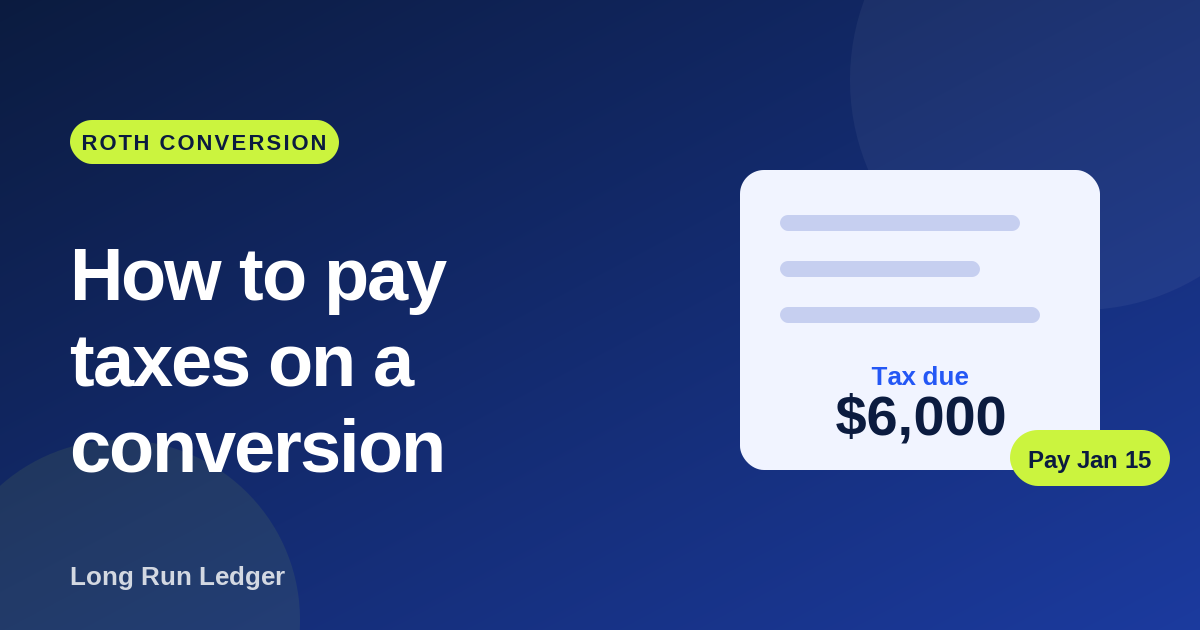
You convert $25,000 and it is all taxed at 24%. The federal tax is $6,000. You could pay it with a $6,000 estimated payment by January 15, or by raising your withholding at work by a similar amount over the remaining paychecks. Your state may add its own tax.
Reporting the conversion
In January you will receive a Form 1099-R showing the amount converted. You report it on Form 1040, and if you have after-tax (nondeductible) IRA money you also file Form 8606. See the pro-rata rule.
Common mistakes
- Forgetting that the conversion can push you into a higher bracket or cut tax credits.
- Not budgeting for state tax.
- Missing the estimated payment deadline.
- Ignoring the effect on Medicare premiums. See retirement tax planning.
See also when to do a Roth conversion and what is a Roth conversion.