Pro-Rata Rule for Roth Conversions Explained (Form 8606)
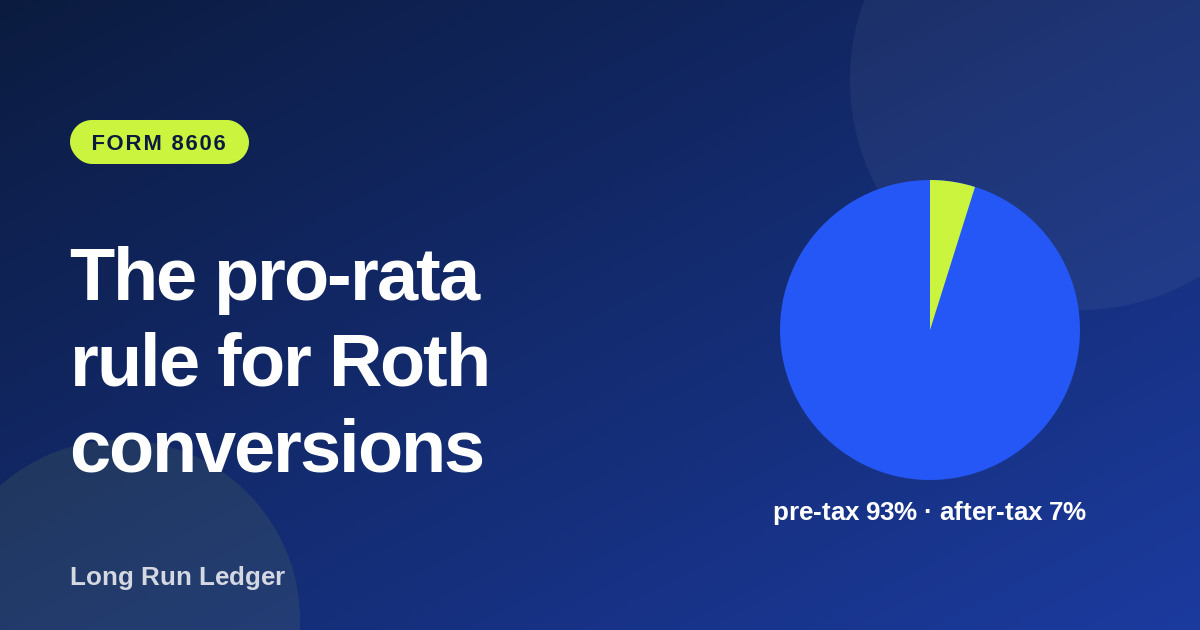
When you convert an IRA to a Roth, the IRS looks at all of your traditional, SEP and SIMPLE IRAs together. If some of that money was already taxed (nondeductible contributions, called basis), a matching share of every conversion is tax-free. That is the pro-rata rule.
The short version: you can’t convert only your after-tax dollars. The tax is split across all your IRA money.
The formula
Tax-free share = after-tax basis ÷ total IRA value. The total is measured at December 31 of the conversion year, plus any amount you converted that year.
Example: you hold $93,000 of pre-tax IRA money and $7,000 of after-tax basis, $100,000 in all. You convert $7,000.
- Tax-free share: $7,000 ÷ $100,000 = 7%.
- Tax-free part of the conversion: $7,000 × 7% = $490.
- Taxable part: $7,000 − $490 = $6,510.
You can’t choose to convert just the after-tax $7,000. The rule treats each dollar converted as a mix of both.
Which accounts count
- Count: traditional IRAs, SEP IRAs and SIMPLE IRAs, including rollover IRAs.
- Don’t count: Roth IRAs, 401(k)s and other workplace plans.
- Each spouse is measured separately.
Why it matters for the backdoor Roth
A backdoor Roth works best when you have no pre-tax IRA money, because the pro-rata rule would otherwise make part of the conversion taxable. See the backdoor Roth guide.
A common workaround
If your employer’s 401(k) accepts incoming rollovers, you can roll your pre-tax IRA money into the 401(k) before December 31. The IRA then contains only after-tax basis, and converting it is mostly tax-free. In the example, moving the $93,000 into a 401(k) first would make the $7,000 conversion about tax-free. Check that your plan accepts it, and that rolling the money in doesn’t cost you investment choices or fees.
Form 8606
You track basis on Form 8606, filed with your tax return in any year you make a nondeductible IRA contribution or take a distribution or conversion. Keep copies. If basis isn’t tracked, you can end up paying tax twice on the same dollars.
Mistakes to avoid
- Ignoring old IRAs when you do a conversion.
- Waiting for the “year-end balance” and assuming earlier balances count.
- Forgetting that other conversions in the year raise the total.
Next: how to convert an IRA to a Roth, how to pay the tax, and the Roth conversion calculator. Confirm details in the Form 8606 instructions.
Related guides: Form 8606 explained