When to Claim Social Security: Ages 62 to 70 Compared
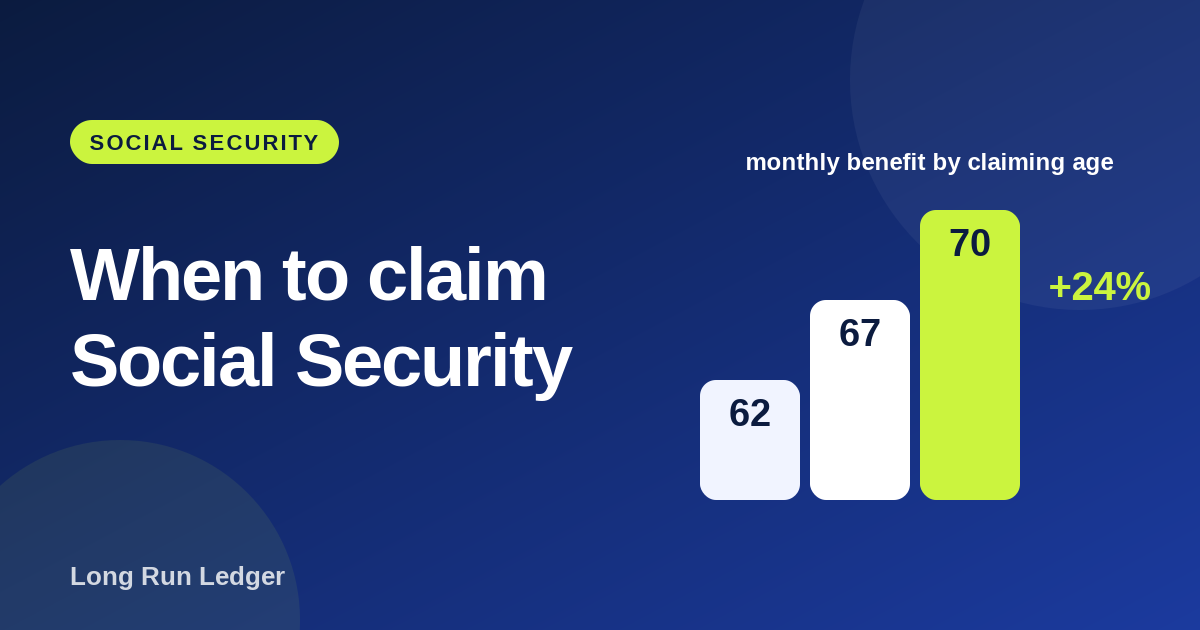
You can start Social Security retirement benefits as early as 62, but the amount depends on when you claim. Your monthly benefit is set for life, apart from yearly cost-of-living adjustments, so the choice matters.
Plan the whole picture. See your amount at every age in the Social Security benefit calculator, then check the break-even calculator.
How much the age changes your benefit
For anyone born in 1960 or later, full retirement age is 67. Compared with your benefit at 67:
| Claim at | Share of your full benefit |
|---|---|
| 62 | 70% |
| 63 | 75% |
| 64 | 80% |
| 65 | 86.7% |
| 66 | 93.3% |
| 67 (full retirement age) | 100% |
| 68 | 108% |
| 69 | 116% |
| 70 | 124% |
Born earlier? Full retirement age is 66 for 1954 and before, rising two months a year to 66 and 10 months for 1959. Benefits stop growing at 70, so there is no reason to wait longer.
An example
Say your full benefit at 67 is $2,000 a month. At 62 you’d get about $1,400, and at 70 about $2,480. That’s $1,080 a month between the earliest and latest choices, for the rest of your life.
The break-even idea
Waiting means collecting fewer checks in exchange for larger ones. The break-even age, where waiting pays off in total dollars, is typically in the late 70s to early 80s depending on the ages compared. If you expect to live past it, waiting tends to come out ahead. If your health or family history suggests otherwise, claiming earlier may make sense. Try your own ages in the break-even calculator.
When to take Social Security: a simple way to decide
- Consider claiming earlier if you need the income now, have health concerns or a shorter life expectancy, or have no other way to cover spending.
- Consider waiting if you are healthy and expect a long life, can cover costs from savings for a few years, or are the higher earner in a couple and want a bigger survivor benefit.
- Full retirement age is a middle path: no reduction, and no extra wait.
How to apply
You can apply up to four months before you want benefits to start, online at ssa.gov, by phone or at an office. Applying a few months early helps avoid a gap. Benefits for a month are paid the following month, so your first check arrives after your first eligible month ends.
Other things to weigh
- Spouses and survivors. The higher earner’s delay increases the survivor benefit, which can matter for a spouse who outlives them.
- Working while claiming early. Before full retirement age, an earnings test can temporarily withhold benefits if you earn above a yearly limit ($24,480 in 2026, or $65,160 in the year you reach full retirement age). Withheld benefits are credited back later.
- Taxes. Up to 85% of your benefit can be taxable depending on your income. See how Social Security is taxed and the Social Security tax calculator.
- Other savings. If you can cover spending from your portfolio for a few years, delaying is a way to buy more lifetime income.
Check your personal estimates and the current rules at ssa.gov. For the other ages that matter, see the retirement age in the USA, and for your target number see how much you need to retire.
Related: Social Security benefit calculator, break-even calculator, retirement calculator.