Retirement Tax Planning: 9 Strategies to Keep More
Most of your retirement tax bill is shaped by choices you can make: which accounts you draw from, when you take income, and how much you convert to a Roth. These nine strategies are the foundation.
Try the numbers. See how much tax a plan creates with the federal income tax calculator.
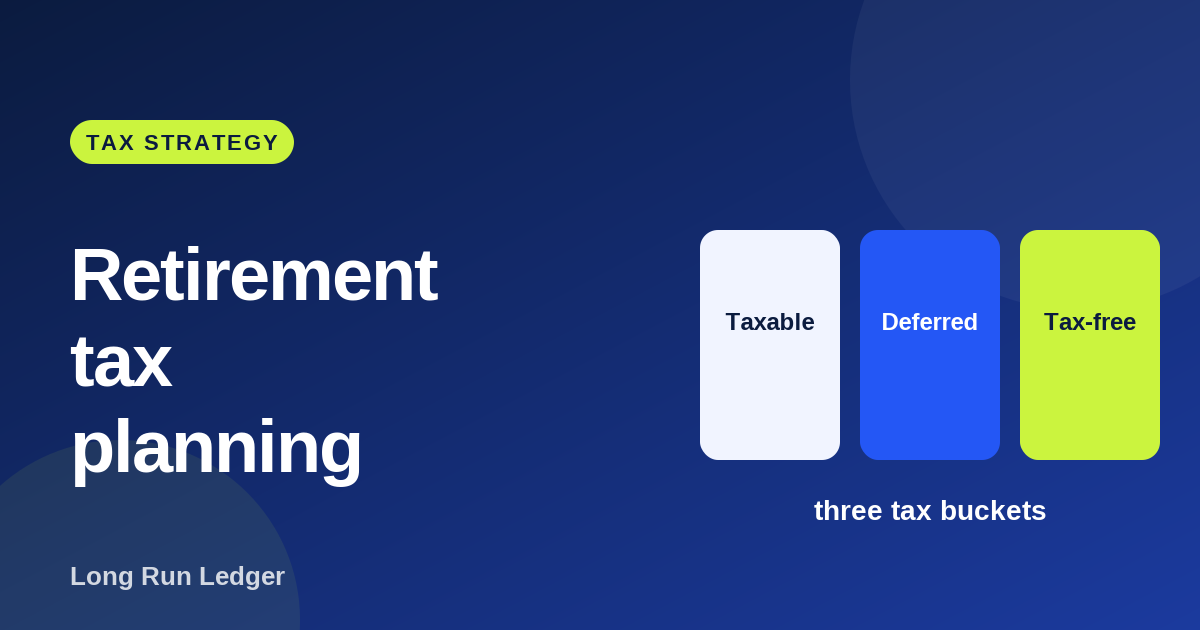
1. Spread money across three tax buckets
- Taxable brokerage accounts: gains are taxed, often at lower long-term rates.
- Tax-deferred (traditional 401(k) and IRA): withdrawals are ordinary income.
- Tax-free (Roth): qualified withdrawals aren’t taxed.
Having all three gives you room to manage your taxable income each year.
2. Know your brackets
Only the slice of income in each bracket is taxed at that rate. Knowing where you stand lets you fill a low bracket on purpose. See 2026 and 2027 federal tax brackets and marginal vs. effective tax rate.
3. Convert to a Roth in low-income years
Moving money from traditional to Roth when your rate is low reduces future withdrawals and RMDs. See when to do a Roth conversion.
4. Choose a withdrawal order, then adjust it
A common default is taxable accounts first, then traditional, then Roth. But a blend often works better, for example taking enough traditional money each year to fill a low bracket and using Roth or taxable money for the rest.
5. Plan ahead for required minimum distributions
RMDs start at 73 or 75 and can raise your tax bracket. Smaller pre-tax balances mean smaller RMDs. See required minimum distributions and the RMD calculator. After age 70½, a qualified charitable distribution can send IRA money to charity without it counting as income.
6. Watch how Social Security is taxed
Up to 85% of your benefit can be taxable once your “combined income” passes $25,000 (single) or $32,000 (married filing jointly), and the thresholds aren’t adjusted for inflation. Withdrawals from traditional accounts raise combined income. See when to claim Social Security.
7. Manage capital gains
Long-term gains are taxed at lower rates than ordinary income, and for lower-income households the rate can be 0%. Selling in years when your income is low can reduce the tax on gains.
8. Mind Medicare premiums
Higher income raises Medicare Part B and D premiums, based on your income from two years earlier (IRMAA). A big Roth conversion can have a delayed effect on premiums.
9. Don’t forget state taxes
Some states don’t tax retirement income, some tax it fully, and some exempt part of it. Where you live in retirement can change your total tax picture.
Where to start
- Estimate your income and tax with the taxable income calculator.
- See what a withdrawal costs with the 401(k) withdrawal tax calculator.
- Price a conversion with the Roth conversion calculator.
- Review your plan each year, and talk to a tax professional before large moves.
Related guides: how Social Security is taxed, Social Security tax calculator