Traditional IRA vs. Roth IRA: Which One Is Right for You?
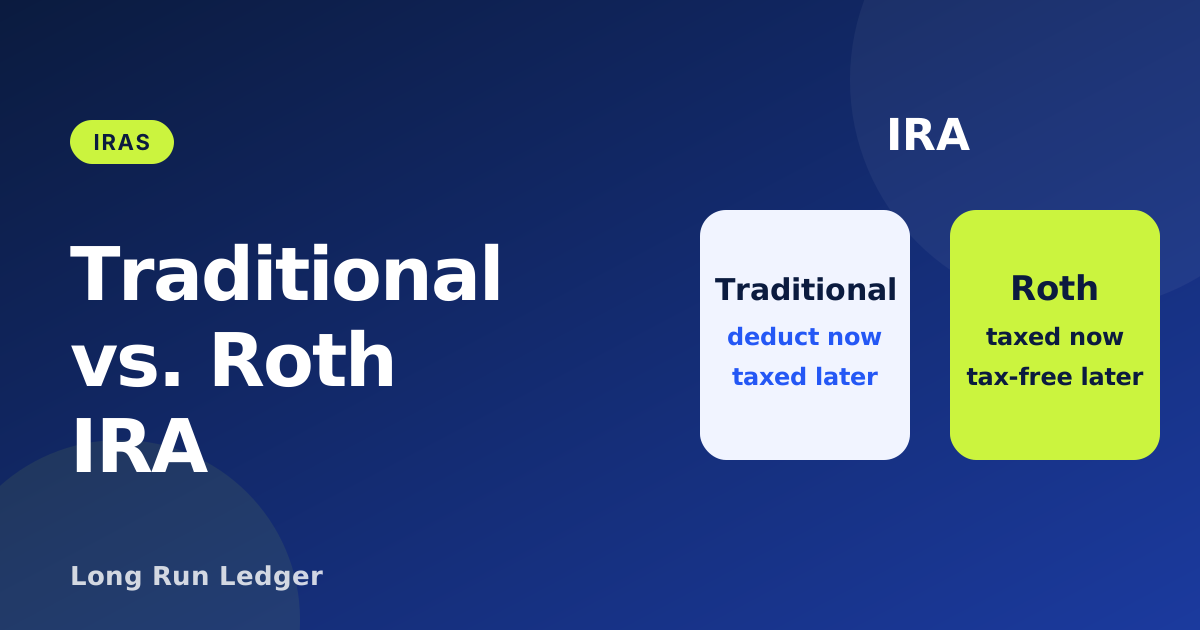
Both accounts let investments grow with tax advantages. The difference is when you pay tax: a traditional IRA may give you a deduction now and taxes you on withdrawals, while a Roth IRA gives no deduction but lets qualified withdrawals come out tax-free.
See your limit. Check how much you can contribute in the Roth IRA calculator.
Side by side
| Traditional IRA | Roth IRA | |
|---|---|---|
| Tax on contributions | May be deductible | No deduction |
| Tax on growth | Deferred | Tax-free if qualified |
| Tax on withdrawals | Ordinary income | Tax-free if qualified |
| Income limit to contribute | None, but the deduction can phase out | Yes, phases out at higher incomes |
| Required withdrawals | Yes, starting at 73 or 75 | None for the original owner |
| 2026 limit | $7,500 ($8,600 at 50+), shared across all your IRAs | |
Which one fits you
- Choose Roth if you expect a higher tax rate later, you’re early in your career, or you want flexibility: contributions can be withdrawn at any time.
- Choose traditional if the deduction is valuable now and you expect a lower rate in retirement.
- Can’t contribute to a Roth? If your income is above the limit, see the backdoor Roth.
The deduction isn’t automatic
If you or your spouse are covered by a retirement plan at work, the traditional IRA deduction phases out at higher incomes. Check the IRS rules for the current ranges. Without the deduction, a traditional IRA loses much of its appeal.
You can change your mind later
Money in a traditional IRA can be moved to a Roth with a conversion, paying tax at that time. For the same choice inside a workplace plan, see Roth vs. traditional 401(k), and the calculator. To open one, follow how to open a Roth IRA.