Form 1099-R Explained: What It Is and How to Read It
Form 1099-R is the tax form that reports money paid to you from a retirement account, pension, annuity or similar plan. If you took a withdrawal, did a Roth conversion or rolled money from one account to another during the year, expect one. Payers generally send it to you by January 31, and they send a copy to the IRS too.
Estimate the tax. Got a 1099-R from a 401(k) or IRA? Use the 401(k) withdrawal tax calculator to see the tax and any penalty.
What Form 1099-R is used for
It covers payouts from traditional and Roth IRAs, 401(k) and 403(b) plans, pensions, annuities and some insurance contracts. It shows how much you received, how much of it is taxable, how much tax was already withheld and a code that tells the IRS what kind of payout it was. It is not the form for Social Security, which uses Form SSA-1099. See how Social Security is taxed.
The boxes that matter most
| Box | What it shows |
|---|---|
| 1. Gross distribution | The total paid out before any tax was withheld. |
| 2a. Taxable amount | The part the payer says is taxable. It can be blank or $0 when the payer can’t tell. |
| 2b. Taxable amount not determined | Checked when the payer couldn’t figure the taxable amount. Traditional IRAs usually have this checked, so you work it out. A “total distribution” box means the account was emptied. |
| 4. Federal income tax withheld | Tax already sent to the IRS for you. You claim it as a payment on your return. |
| 5. Employee contributions | After-tax money, designated Roth contributions or insurance premiums included in the payout. |
| 7. Distribution code | One or two characters that tell the IRS what type of payout it was (see below). |
| 14. State tax withheld | State income tax taken out, if any. |
Box 7 distribution codes
| Code | Meaning |
|---|---|
| 1 | Early distribution, no known exception. The 10% additional tax may apply. |
| 2 | Early distribution, exception applies. No 10% additional tax. |
| 3 | Disability. |
| 4 | Death benefit paid to a beneficiary. |
| 7 | Normal distribution, generally age 59½ or older. |
| G | Direct rollover to another plan or IRA. Usually not taxable. |
| H | Direct rollover from a designated Roth account to a Roth IRA. |
| B | Distribution from a designated Roth account in a 401(k) or 403(b). |
| J | Early distribution from a Roth IRA, no known exception. |
| Q | Qualified distribution from a Roth IRA. |
| T | Roth IRA distribution where an exception applies or the five-year period isn’t known. |
The IRS lists more codes, and some forms show two (for example 1 and G). If your code looks unfamiliar, check the IRS Instructions for Forms 1099-R.
Where it goes on your tax return
IRA and Roth IRA payouts go on Form 1040 line 4, and pensions, annuities and 401(k) payouts on line 5. Put the gross amount on the “a” line and the taxable amount on the “b” line. Report federal tax withheld in Box 4 with your other withholding. If you got an early-distribution code 1, you may also owe the 10% additional tax on Form 5329 unless an exception applies. See the early withdrawal penalty and its exceptions.
Rollovers and Roth conversions
- Direct rollover (code G): you still get a 1099-R, but the taxable amount is generally $0. Report the amount on the “a” line and $0 on the “b” line.
- Roth conversion: expect a 1099-R for the amount converted, usually with Box 2b checked. You report the taxable part using Form 8606. See Form 8606 explained and how to convert an IRA to a Roth.
- Roth IRA withdrawals: codes J, Q or T. See Roth IRA withdrawal rules.
Withholding on retirement payouts
Payouts from a 401(k) or similar plan that you could roll over generally have 20% federal tax withheld. IRA withdrawals are often withheld at 10% unless you choose a different amount or none. Withholding is a prepayment, not the final tax: you may owe more or get some back. For how rates apply, see how 401(k) withdrawals are taxed.
A simple example
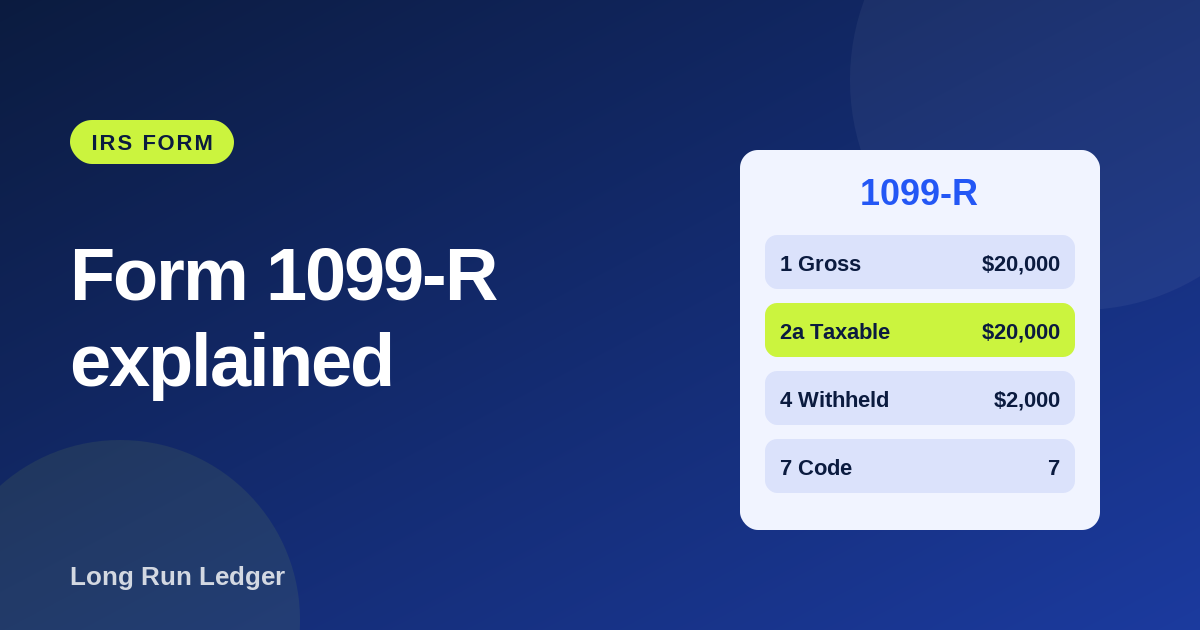
Jordan, 62, withdraws $20,000 from a traditional IRA and asks for 10% withholding. The 1099-R shows $20,000 in Box 1, $20,000 in Box 2a, $2,000 in Box 4 and code 7. Jordan adds $20,000 of taxable income, pays tax at the normal bracket rates and counts the $2,000 as tax already paid.
If it’s wrong or missing
- Wrong amounts or codes: ask the payer for a corrected 1099-R before you file.
- Not received by mid-February: check your online account first, then contact the payer. You still must report the income.
- More than one form: you may get several, one per payer or account. Add them all up.
Related: retirement account tax deadlines, retirement taxes hub, RMD calculator.