In-Plan Roth Conversion: Convert a 401(k) to a Roth 401(k)
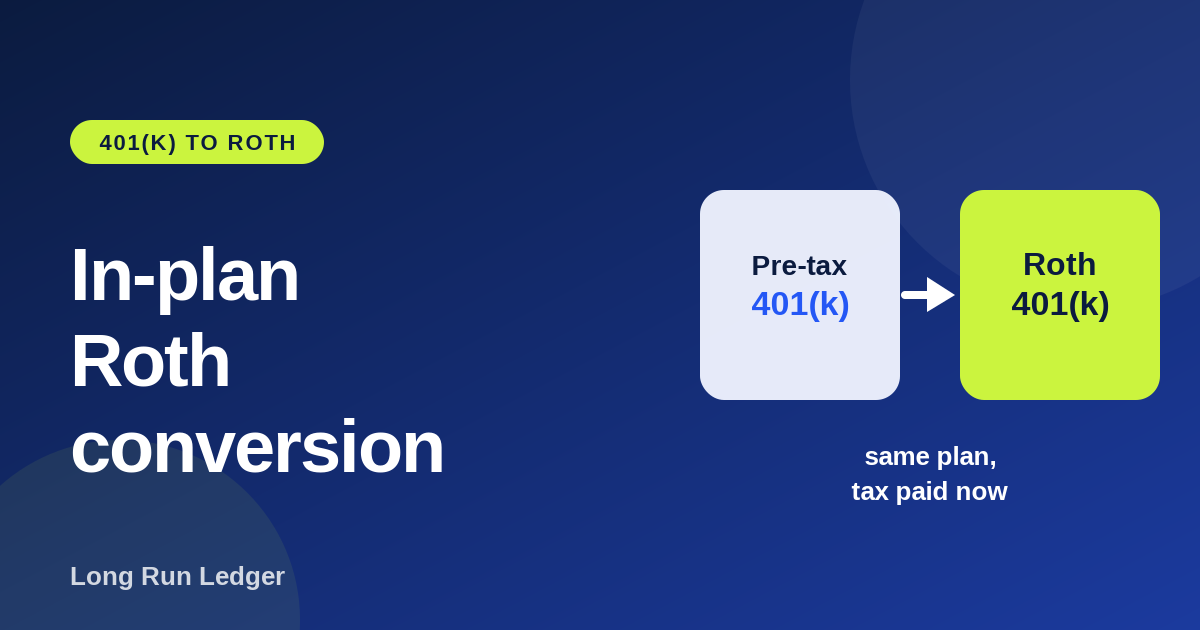
An in-plan Roth conversion lets you move pre-tax money inside your 401(k) or 403(b) into the plan’s Roth account, without taking it out of the plan. You pay income tax on the converted amount now, and in return qualified withdrawals later are tax-free.
Price it first. Enter the amount in the Roth conversion calculator to see the tax bill by bracket.
How it works
You tell your plan to convert part (or all) of your traditional balance. The pre-tax amount is added to your income for that year and taxed at ordinary rates. The money then sits in the Roth 401(k), where it grows tax-free, and the converted dollars are never taxed again.
Not every plan allows it. The plan needs a Roth account and must permit in-plan conversions, and some limit which money sources can be converted. Ask your plan administrator, or look in the summary plan description.
In-plan conversion vs. rolling to a Roth IRA
| In-plan (Roth 401(k)) | Roth IRA rollover | |
|---|---|---|
| Where the money goes | Roth account in the same plan | An IRA you control |
| Available while working? | Yes, if the plan allows it | Usually only after leaving the job |
| Required minimum distributions | None for Roth 401(k)s since 2024 | None for the original owner |
| Investment choices | The plan’s menu | Almost anything |
| Tax when converted | Ordinary income on the pre-tax amount | |
What it costs: an example
A single filer earns $90,000 in 2026. After the $16,100 standard deduction, taxable income is $73,900, in the 22% bracket, which runs up to $105,700. That leaves $31,800 of room. Converting $20,000 adds $20,000 of income taxed at 22%, so the federal tax is about $4,400. A bigger conversion would spill into the 24% bracket. See the 2026 and 2027 brackets.
Pay the tax from outside the plan
If you have the plan withhold tax out of the conversion, the withheld part is generally treated as a distribution instead of a conversion. Under 59½ it can also trigger the 10% early-withdrawal penalty. Paying from savings keeps the full amount working in the Roth. See how to pay taxes on a Roth conversion.
Rules to know
- No undo. Since 2018 a conversion can’t be recharacterized back to traditional.
- Deadline: it counts for the year it happens, so it must be completed by December 31. Plans often set earlier processing cutoffs, so ask in advance.
- Five-year rules: qualified Roth 401(k) withdrawals of earnings need age 59½ and five years since your first Roth contribution or conversion in that plan. Each conversion also has its own five-year clock for the 10% penalty if you are under 59½. See the Roth five-year rule.
- Paperwork: you will get a Form 1099-R in January showing the conversion.
When it can make sense
- Your income is low this year and you expect higher tax rates later.
- You can pay the tax from non-retirement money.
- You have a large pre-tax balance and want to reduce future required minimum distributions.
- Your plan allows converting after-tax contributions (sometimes called a mega backdoor Roth), which keeps taxable earnings small if you convert quickly.
When to wait
- You will need the money within about five years.
- You would have to use the converted money to pay the tax.
- The conversion would push you into a much higher bracket or raise Medicare premiums.
Steps
- Confirm your plan offers in-plan Roth conversions.
- Estimate the tax in the Roth conversion calculator.
- Choose an amount, often one that fills your current bracket. See when to do a Roth conversion.
- Submit the request to your plan before its cutoff.
- Set aside the tax, and report the conversion when you file.
Related: what is a Roth conversion, Roth vs. traditional 401(k).