Roth IRA vs. 401(k): Which Should You Fund First?
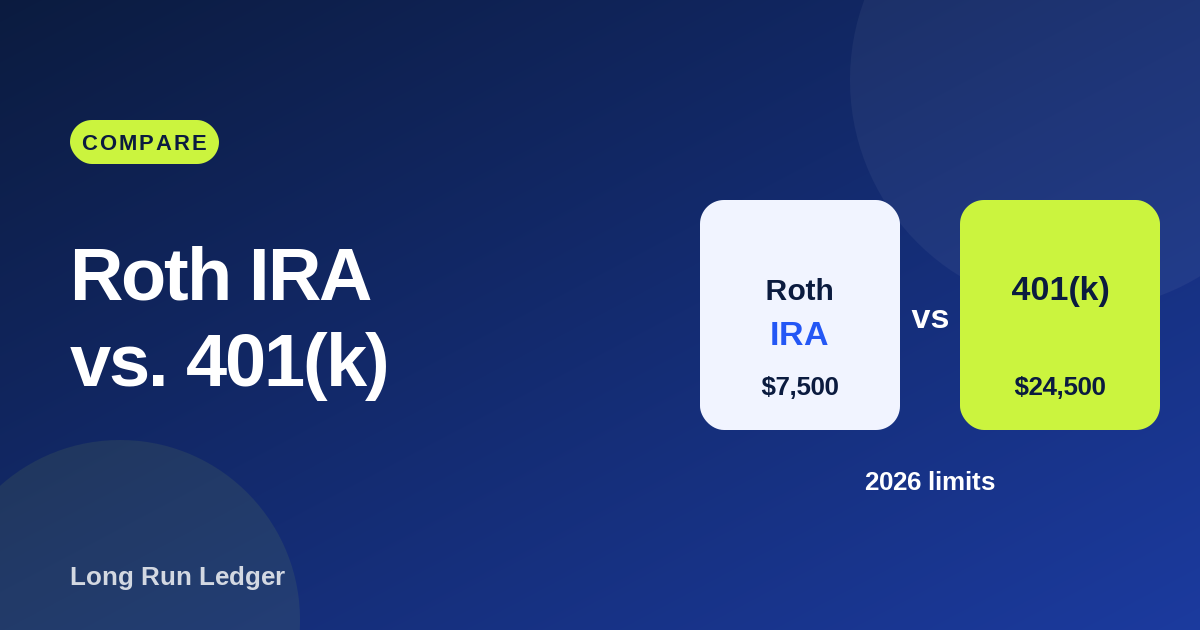
A Roth IRA and a 401(k) are two different accounts with different rules. The 401(k) is offered by an employer and has a high contribution limit and sometimes a match. The Roth IRA is yours to open anywhere, with more investment choices but a lower limit.
You don’t have to choose. Many people use both. The question is which one to fund first.
Side by side (2026)
| Roth IRA | 401(k) | |
|---|---|---|
| Who offers it | You open it yourself | Your employer |
| Contribution limit | $7,500 ($8,600 at 50+) | $24,500, plus $8,000 at 50+ ($11,250 at 60–63) |
| Employer match | None | Often |
| Tax treatment | After-tax now, tax-free later | Traditional: deduction now, taxed later. Roth 401(k): like a Roth IRA |
| Income limit | Yes: single $153,000–$168,000, joint $242,000–$252,000 | None |
| Investment choices | Almost anything you can buy at a brokerage | The plan’s menu |
| Required minimum distributions | None for the owner | Traditional: yes. Roth 401(k): none |
| Early access | Contributions anytime; earnings after 59½ and five years | Generally 59½, with exceptions such as the rule of 55 |
A common order for funding them
- Contribute to your 401(k) up to the employer match. A match is an immediate return. See 401(k) employer match explained.
- Max out a Roth IRA if your income allows. It has more investment choices and often lower fees.
- Go back to the 401(k) and raise your contribution toward the limit.
- Then consider a taxable account.
This is a starting point, not a rule. If your 401(k) has high fees, or you expect a high tax rate now and a low one later, the order can change. A health savings account can also come before some of these steps.
Which tax treatment: Roth or traditional?
If you expect a lower tax rate in retirement, traditional contributions (401(k) or deductible IRA) often win. If you expect a higher rate, or want tax-free income and no RMDs, Roth wins. Many people mix both. See Roth vs. traditional 401(k) and the Roth vs. traditional calculator.
Over the income limit?
High earners can’t contribute directly to a Roth IRA, but may use a backdoor Roth, or a Roth 401(k) if their plan offers it, since it has no income limit.
Quick answers
- Can I have both? Yes. The limits are separate.
- Which has more tax-free growth room? The 401(k), because the limit is higher.
- Is a Roth IRA better for early access? Contributions can be withdrawn anytime, which is more flexible. See the early-withdrawal penalty guide.
To open a Roth IRA, follow how to open a Roth IRA. To find the limits for each year, see Roth IRA contribution limits and what is a 401(k).