Roth Conversion Ladder: How Early Retirees Access Their Money
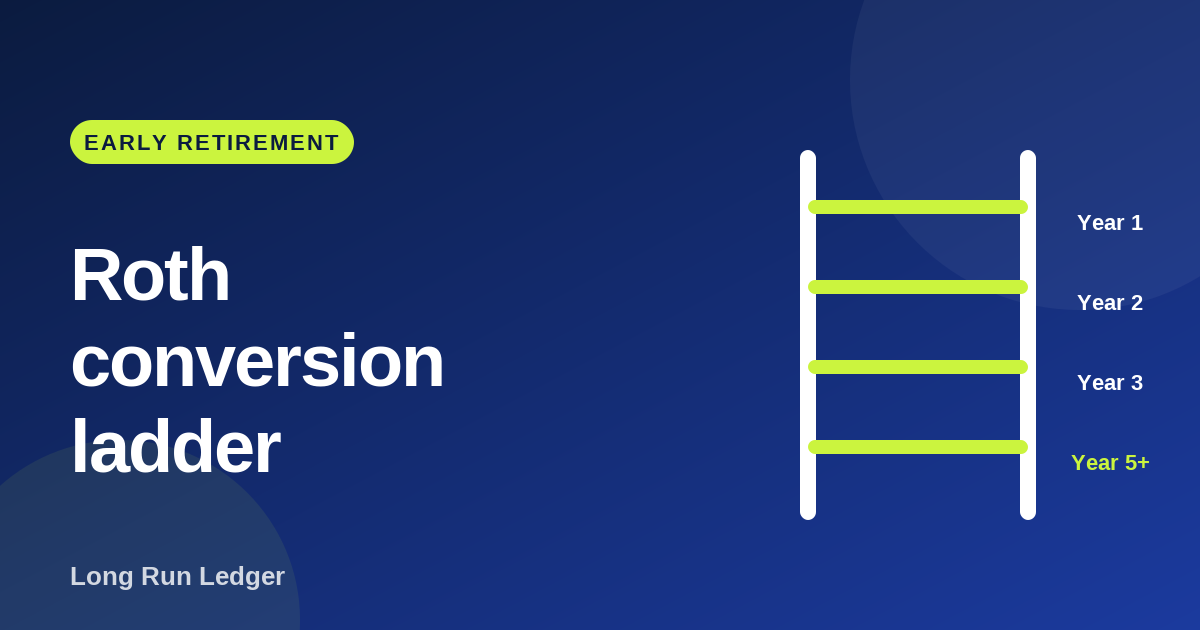
If you retire in your 40s or 50s, most of your savings may be in pre-tax accounts you can’t touch without a 10% penalty until 59½. A Roth conversion ladder is a common way around that. It spreads conversions over several years so that money becomes available penalty-free after a five-year wait.
Test the tax cost. Use the Roth conversion calculator to see what a yearly conversion would cost.
How the ladder works
- Convert a slice each year. Move money from a traditional IRA (or an old 401(k) rolled into one) into a Roth IRA, and pay income tax on it.
- Wait five years. Each conversion has its own five-year clock (see the five-year rule).
- Withdraw the converted amount. After five years, that year’s converted principal can come out without the 10% penalty, even if you’re under 59½.
- Repeat every year. Each year you convert a new rung and a rung from five years ago becomes available.
What do you live on in the first five years?
You need a bridge: taxable savings, Roth IRA contributions (which can be withdrawn any time), cash, or part-time income, as in Barista FIRE. Many people start the ladder a few years before they stop working.
Why it can be cheap
With no other income, the standard deduction and the low brackets cover a lot of conversion. In 2026 a single filer has a $16,100 standard deduction, and the 10% and 12% brackets run up to $50,400 of taxable income. So a conversion of up to $66,500 with no other income is taxed at 12% or less: $5,800 in federal tax in total (10% on the first $12,400 and 12% on the next $38,000). That’s about 8.7% on average. The calculator uses the full 2026 and 2027 brackets.
What to watch
- Health insurance subsidies. Conversion income counts toward ACA subsidy eligibility, so a bigger conversion can reduce subsidies.
- State income tax may apply.
- Don’t withdraw early. Pulling out a conversion before its five years can trigger the 10% penalty.
- Pay tax from outside money if you can, so the conversion isn’t shrunk by withholding.
- Tax rules change. A ladder is a multi-year plan, so check the rules each year.
New to conversions? Start with what a Roth conversion is and how to convert step by step. If you plan to retire early, work out your target with the FIRE calculator.
Related tax guides: when to convert, early-withdrawal penalty and exceptions, 72(t) payments, rule of 55