Roth IRA Withdrawal Rules: When and How to Take Money Out
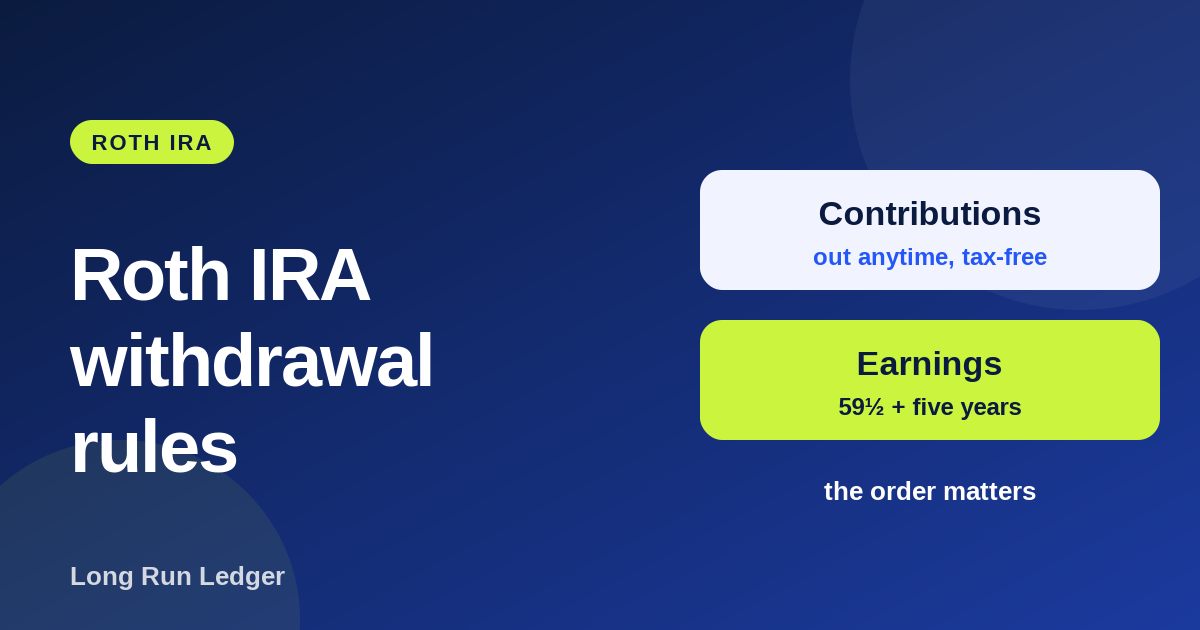
You can take out the money you put into a Roth IRA at any time, at any age, with no tax and no penalty. Earnings are different: they come out tax-free and penalty-free only if the withdrawal is a “qualified distribution.” Here is how the rules work.
Check the five-year clock. Read the Roth five-year rule explained simply before you take out earnings.
Contributions vs. earnings
A Roth IRA holds two kinds of money. Your contributions were already taxed, so you can withdraw them whenever you like. The earnings are the growth on top. Taking earnings out early can trigger income tax and a 10% additional tax.
When a withdrawal is “qualified” (tax-free)
A distribution is qualified, and entirely tax-free, if both of these are true:
- The five-year period is met. It starts January 1 of the first tax year you made a contribution to any Roth IRA of yours.
- You have a reason: you are 59½ or older, disabled, the money goes to a beneficiary after your death, or you use it for a first home (up to $10,000 lifetime).
The order money comes out
When you withdraw, the IRS treats the money as coming out in this order:
- Regular contributions, tax-free and penalty-free.
- Conversion and rollover amounts, oldest first.
- Earnings, last.
Example
Sam, 45, has put $20,000 into a Roth IRA over the years and it is now worth $35,000. Taking $10,000 comes entirely from contributions: no tax, no penalty. Taking $30,000 uses all $20,000 of contributions plus $10,000 of earnings. Because Sam is under 59½ and no exception applies, the $10,000 of earnings is taxable and the 10% additional tax is $1,000.
Roth conversions have their own clock
Money you converted from a traditional IRA can be withdrawn without income tax (you already paid it), but each conversion has its own five-year period for the 10% additional tax. Taking the converted amount out within five years and before 59½ can trigger the 10%, unless an exception applies. See the Roth conversion ladder.
Exceptions to the 10% additional tax
Before 59½, the 10% can be waived for reasons including disability, death, substantially equal payments, a first-home purchase up to $10,000, qualified higher education costs, unreimbursed medical costs above 7.5% of income, health insurance while unemployed, a birth or adoption up to $5,000, a limited emergency expense of up to $1,000 a year, and some disaster and abuse-related withdrawals. These waive the penalty, but earnings may still be taxable if the withdrawal isn’t qualified. Details are in the early withdrawal guide and 72(t) payments.
Other things to know
- No required minimum distributions for the original owner of a Roth IRA, at any age.
- Reporting: your custodian sends a Form 1099-R (codes Q, J or T). If you took a distribution you may need Form 8606. See Form 1099-R explained and Form 8606.
- You can’t put it back except as a rollover within 60 days, or as a new contribution within annual limits. See Roth IRA contribution limits.
- Keep records of your contributions. Your custodian may not track your basis.
How to take a withdrawal
- Log in to your account or call your custodian and request a distribution.
- Choose how much and whether to withhold tax.
- Tell them if it is a qualified or an early distribution, or to withdraw contributions only.
- Keep the 1099-R that arrives the next January for your tax return.
Compare this with traditional accounts in traditional vs. Roth IRA, and see the Roth IRA calculator.